Actors & their Roles
General overview
In order to provide a better understanding of how the B2B2C is intended to work, this chapter provides a short summary of each role in the DEUSS ecosystem. At a high level, an issuer or investor never touches infrastructure directly — they go through a Broker, which operates its own onboarding, validation, and — where applicable — guarantee functions internally or through outsourced validation resources. The Core exchange (DEUSS) operates the shared platform, coordinates payments through a PSP, and settles everything on EBSI.
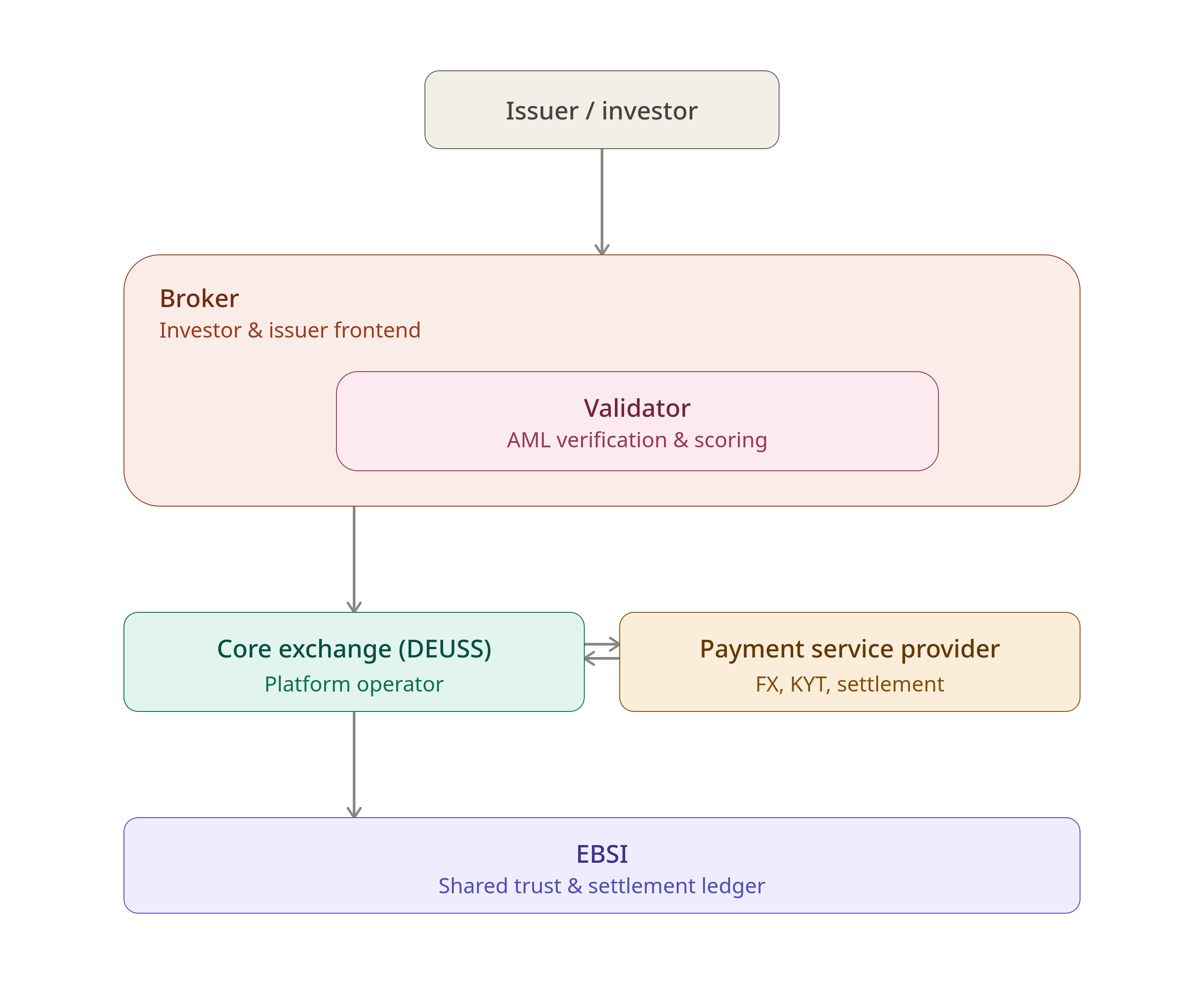
- Issuer / investor — the end customer: a company raising a bond, or a buyer holding one.
- Broker — the distributor-branded storefront the customer actually uses. Internally, a Broker operates or orchestrates its validation function (checking who the customer is and, for issuers, how creditworthy they are) and can provide guarantee backing for specific issuances. Validation activities are performed through the Validator application/environment, which is used by dedicated Validator (Compliance), Validator (Risk Analyst), and Validator (Placement Agent) roles. These roles may be performed by Broker employees or, where the Broker outsources part of its validation activities, by external personnel acting on the Broker's behalf. The Broker may also employ or engage other roles such as an Underwriter and Guarantor.
- Core exchange (DEUSS) — runs the shared platform and is the only party that talks to the ledger.
- Payment service provider — moves the actual money (fiat rails, FX, settlement).
- EBSI — the shared ledger where entities, bonds, and trades ultimately live.
Detailed overview
Issuer / investor
- General: the two customer-facing roles — someone who issues a bond, and someone who buys or holds one.
- Technical: both are provisioned as a generic
EntityinEntityRegistryand share the exact same status lifecycle (ENABLED,DISABLED). They are differentiated only by an assignedtypeId. Wallets are deployed viaWalletFactoryasCompanyWalletinstances, and per-wallet execution rights are governed byPolicyRegistryrather than hardcoded per role.
Broker
-
General: the distributor running its own branded storefront on top of the shared platform, through which its issuers and investors trade. A Broker also operates or orchestrates its own validation and, where applicable, guarantee functions. The validation function is accessed through the Validator application/environment, where the relevant approval and assessment activities are performed by Validator (Compliance), Validator (Risk Analyst), and Validator (Placement Agent). These Validator roles describe the function performed in the DEUSS processes rather than a mandatory employment relationship: depending on the Broker's operating model, the respective Validator may be a Broker employee or an external/outsourced person acting on the Broker's behalf.
-
Technical: a full whitelabel deployment (Payment, Company, Bond issuance, User profile, Blockchain Indexer, Eventer, Notification services) with its own Keycloak IDP and its own relational store/event bus. Brokers never call EBSI directly — all on-chain commands are relayed to the Core exchange's Core EBSI Gateway over authenticated REST (mTLS), which is the single blockchain entry point. Two of the Broker's internal responsibilities map to distinct on-chain effects:
- KYC/AML validation: performed through the Validator environment by Validator (Compliance) and feeds entity onboarding and lifecycle decisions gated by the
ONBOARDINGandGUARDroles inEntityRegistry— registering entities/accounts and setting theirENABLED/DISABLEDstatus. - Issuer scoring: once an issuer's KYB/verification is complete, Validator (Risk Analyst) uses the validation environment to perform or initiate the issuer risk assessment. The platform requests a scoring record (
gradeA–E,defaultProbability,issueDate,expirationDate) from an external distributor/scoring provider. A scoring can only be requested if the issuer has no scoring alreadyPENDING/CREATEDand no unexpired completed scoring. Once completed, it is synced and notarized on-chain viaappendScoring(wallet, scoring)onBondRegistry, gated by theSCORINGrole — an append-only, per-wallet history addressed by a 1-based scoring ID and tagged with adistributorId. - Bond placement: once an issuance clears the required validation and approval steps, Validator (Placement Agent) uses the Validator environment to perform the placement-related activities and manage distribution of the bond to the investor base.
- KYC/AML validation: performed through the Validator environment by Validator (Compliance) and feeds entity onboarding and lifecycle decisions gated by the
-
Roles within a Broker
| Function | Responsibility |
|---|---|
| Validator (Compliance) | Performs onboarding-related compliance activities, including KYC/AML checks and validation of the customer. The role operates through the Validator application/environment and may be performed by a Broker employee or an outsourced person acting on the Broker's behalf. |
| Validator (Risk Analyst) | Performs issuer risk assessment and credit scoring activities through the Validator application/environment, feeding the platform's on-chain scoring records. The role may be performed by a Broker employee or an outsourced person acting on the Broker's behalf. |
| Validator (Placement Agent) | Performs placement-related approval/distribution activities through the Validator application/environment once the bond has cleared the required validation steps. The role may be performed by a Broker employee or an outsourced person acting on the Broker's behalf. |
| Underwriter | Evaluates and prices the risk of a bond issuance before it is offered to investors. |
| Guarantor | Provides credit enhancement or financial guarantees for specific bond issuances, securing the issue to mitigate investor risk; the guarantee terms are registered alongside the bond's parameters (e.g. referenced in the bond's on-chain metadata / BondRegistry record). |
Core exchange (DEUSS)
- General: the platform operator — runs the shared infrastructure every broker and the ledger plug into, and is the only party authorized to write to the chain.
- Technical: owns platform governance (Backoffice, Keycloak), Business Registry, Core Payment, Eventer, Blockchain Indexer, the CDC/analytics pipeline, and the Core EBSI Gateway — the HA service that submits signed transactions and handles VC/DID flows on EBSI for itself and all brokers. Its accounts typically hold the protocol's administrative roles (
ADMIN_ROLE/ENTITY_TYPE_MANAGERonEntityRegistry,PUBLISHER/CURRENCY/SUSPENDonBondRegistry,ADMINonMarketplace/EscrowManager).
Payment service provider (PSP)
- General: the external banking partner that actually moves fiat money — FX conversion, transaction screening, settlement.
- Technical: never touches the chain. Core Payment matches on-chain deal/payday events to buyer/seller IBANs (from the company service), creates payment records, and calls the PSP's API to initiate and later confirm settlement; confirmed payments are relayed back on-chain to release escrowed tokens via
EscrowManager/AssetManager.
EBSI (shared ledger)
- General: not a human actor, but the trust layer everything else settles against — identities, bonds, and trades all end up here.
- Technical:
EntityRegistry/PolicyRegistry/WalletFactory/CompanyWalletsfor identity and wallet control,BondRegistryand the ERC-6909DEUSS Tokenfor issuance and lifecycle (including scoring history), andMarketplace/EscrowManager/AssetManagerfor market operations. Off-chain data (KYC/KYB documents, payments) deliberately stays off-ledger.